Friday, August 25, 2017

God's Thumbprint


Burke’s Garden, Virginia


Geographic anomalies fascinate my husband and fellow traveler, Klep who is a civil engineer both in temperament and in training.  When he recently read an article describing the high mountain valley known as Burke’s Garden, he put it on our day trip list for a future trip to Winegar Hollow.

The future arrived yesterday morning.  We awoke to a lovely late August day when a little October invaded August, a fine day for a mountain ramble which we started at the Hitching Post Diner
on Highway 11W near the turnoff for Stanley Valley Road where our cook was also waitress.  She operates the diner during the week, closing every day except Friday which is catfish day at three.  On catfish day her day is 17 hours long.  I can understand why she closes on the weekend!


After a fine East Tennessee breakfast including some of the finest biscuits we’ve had lately and some nicely cooked fried eggs, soft yellows, crispy on the edges whites, complimented with sausage gravy, we passed through the edge of Kingsport and over the Virginia line to Gate City where we, by chance, managed to land on the correct road the wind us through the mountains, past Lebanon and on to Tazewell, the closest incorporated town to the area known as Burke’s Garden, Virginia.

As we travelled, we twisted around curves, gained elevation, and enjoyed the intense green of the roadsides decorated with banks of blooming goldenrods and the lower brilliant blue from the late summer chicory.  Occasionally we passed a garden in a low flat spot near a house and the road which made us green with envy, the corn on the stalk just maturing, and tomatoes ripening on the vines. 

As we entered Tazewell, Virginia, not to be  confused with Tazewell, Tennessee or New Tazewell, Tennessee, we passed a brightly painted sign advertising Donut Diva on Main Street, but we did not see it as we passed through and found Burke’s Garden Road which would lead us rather circuitously to our destination.  We filed that information for the return trip.  Who doesn’t occasionally need a doughnut!

Our surroundings became even more beautiful as the altitude became higher.  At first we passed a few mini-mansions, but then the trees thickened, the climb became steeper, and the curves, sharpened.  I held on to the edge of the seat a few times and reminded myself to breathe although the road was actually quite a good one and it did have a line down the center.  My East Tennessee husband was thoroughly enjoying the drive!  We were soon over three thousand feet high and climbing.  We wondered as we enjoyed the luxury of making the trip in the car what it must have been like for the band of men who accompanied the surveyor Burke to this area in 1745 who tramped up this mountain with only their feet to carry them and no road.  As we climbed, the temperature dropped to the point that when we leveled out and saw the valley stretched out in front of us, the temperature was down to sixty degrees and the elevation was well over three thousand feet.
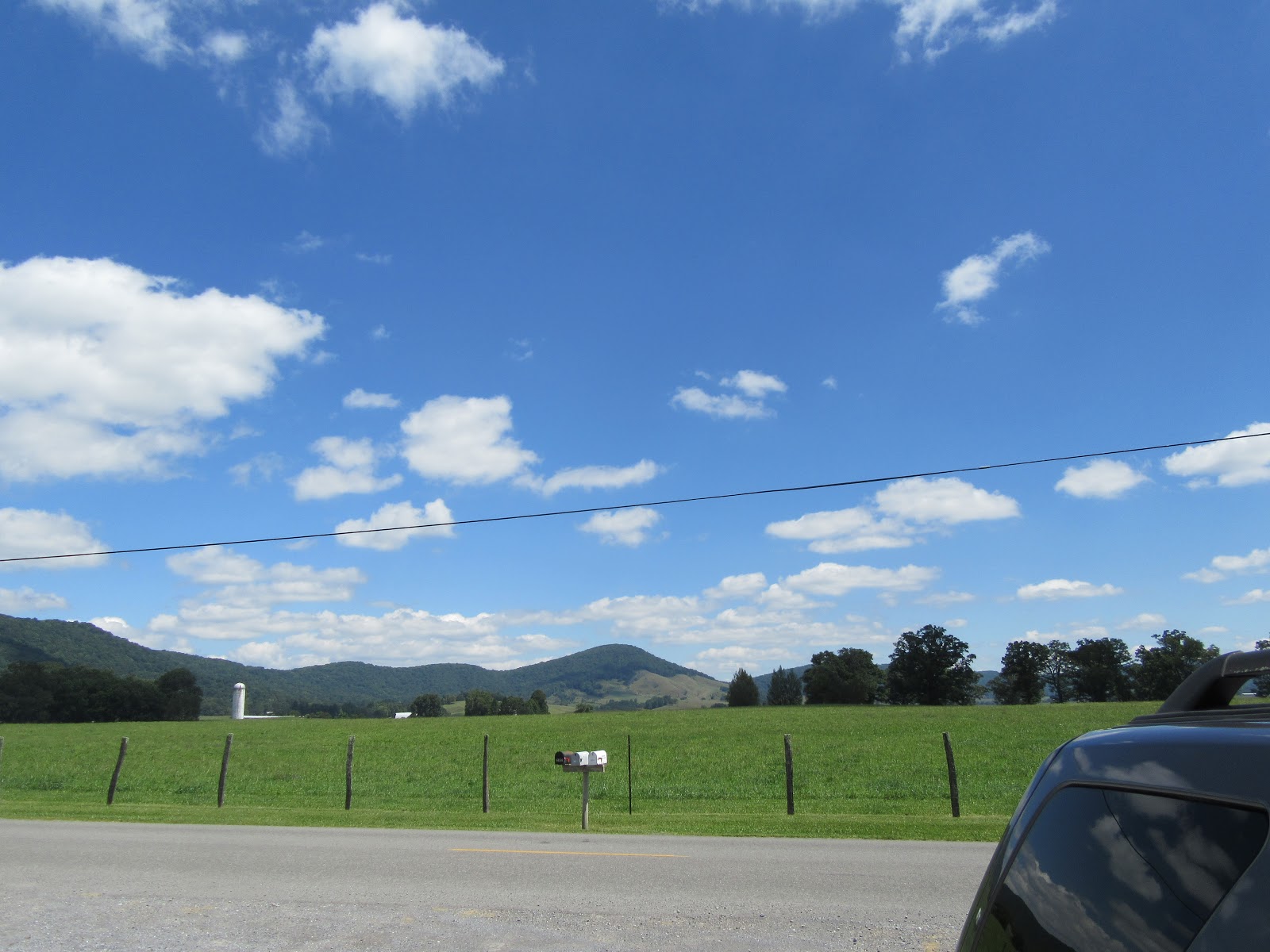

As we slowed at the approach of the Amish Country Store, the one and only retail establishment for the area, we were amazed at the vast pastures and fields stretching to the rims of the ranges surrounding them.  Occasionally we could see the buildings for the farms.

We had been on the road for almost three hours although we had driven only about one hundred and thirty miles.  We knew that the country store served sandwiches.  As we drove in, two other cars joined us in the parking lot.


Two young Amish women with their little white hats and traditional dresses made our sandwiches and also took care of other customers as we waited.  One customer, traditionally dressed,  came in for a bulk order and I enjoyed overhearing the conversation although I could understand none of it, for it sounded much closer to German than English.  As we waited, we fell into conversation with those who had followed us into the store.  The couple now own a farm in the valley, retired from Minnesota, and the other gentleman was from Nashville, Tennessee and seemed to be on a genealogy trip.  The couple from Minnesota had renovated a hundred and eighty year old farmhouse and had always wanted to live on a farm when they bought their farm, complete with a herd of goats. The first summer they occupied the house there was no running water.  They learned how to survive the way it used to be.   We later drove past their farm which is a show place now, the old two story house stuccoed over three brick deep walls.

While we ate our thick ham and cheese sandwiches on homemade sourdough bread  on the wide front porch, a couple of motorcycle riders rode up.  I was amused to listen to them talk as though they would not be welcome in the area.  After they got their helmets and jackets off, they looked pretty harmless and run of the mill to me.  I find it somewhat amusing that just because people ride a two wheeled vehicle that it somehow changes their won persona and makes them tough dangerous people.  Ah, well, to each his own.  They did not seem to be looking for conversation.

After we finished eating, we wandered back inside and paid the young women.  We were sorely tempted to buy a pan of cinnamon rolls, but we resisted and drove up and down the small roads of “The Garden.”

Mrs. From Minnesota had recounted that the name of the area came from when the surveyors buried the peelings from the potatoes they peeled and boiled for supper when they were camping in the valley.  They did not want to leave any sign that they had been there since the natives were occasionally a little less than friendly back in 1745.  The following year when others followed into the area, they found potatoes growing there from the peels buried.  Now the potato plays an important part in the annual festival.

We passed the old school which is now closed (The few school children who live in the valley are bused down to Tazewell.), the old closed post office,


lots of farms, silos, cows, goats, cornfields, hay fields, and creeks.  The area has never been developed because for a very long time, the owners would not sell any land.  In fact, it is believed that Vanderbilt wanted to build his Southern mountain retreat there and even he did not have money enough to tempt the owners.  I can understand that they truly did believe that it was “God’s Thumbprint.”

After an hour driving around with the windows down, relishing the smells of mown hay and the colors of the flowers, we turned and started down the rollercoaster road.  We stopped at an overlook, but very little could be seen because of the foliage, but we could glimpse down into the valley at some of the farms we had seen.


We were blessed by spotting “Donut Diva” as we made our turn onto Main Street in Tazewell.  Klep got  a Cappuccino to fortify him for the drive back to the hollow and we each chose two of her doughnuts.  Klep got one which had blue berries with, white frosting, and blueberry drizzle.  I got a German chocolate one.  We each got a vanilla frosted one with chocolate drizzle which we saved for breakfast.  The young woman who owned the little shop told us that she had been in business for three years.  She had a list of orders hanging in her window and was still busy preparing more doughnuts while we were there.  After sampling her product, we could understand why she was doing well!


We found US19, traveled down to I 81, joined rush hour on the interstate, got off on 11W after we passed Bristol, and arrived home after six. 

We feel blessed to have seen one of God’s unique geographical creations.  His work is indeed magnificent.

Wednesday, July 26, 2017

Coming to America

The wake up phone call filled the room as the lights flashed on and off at five a.m.  Friday.  We had an early flight home and needed to be at the Bucharest Air Terminal two hours in advance of our flight.  Thirty minutes later, our backup call came, but by this time, we were dressed, the bags were outside the door and we were doing our little check to be sure we had not left anything.

So far, our only mishap had been when I bumped my eye brow into the glass shelf above the plug in kettle that I heated the water in for our cups of Nescafe instant, a common offering in European hotel rooms.

We took the elevator down to the opulent reception area, checked out and received our breakfast box.  Since we did not need anything else to carry, we found a table and had our snack.  We had a tomato and cheese sandwich, a little muffin, a piece of fruit, an energy bar, and 16 ounces of water.  The bars and fruit went into the tote bag for later.  We started the water.  It is very important to stay hydrated when flying long distances.

Our big bus was in front of the Hilton a little before six.

The square in front of the hotel with all its old buildings was pretty much deserted in the early morning under the clear blue summer sky.  It had been bustling with cars and people when we came in from dinner the night before.

Our Viking representative checked us off and found two were missing.  She went back inside and soon returned.  They had decided to extend a couple of days.  I was wishing that we could, too, but we were packed and boarded and it was a little too late to back up.
h.
The bus moved quickly through the streets which had been clogged with traffic when we were on them Thursday.  In less than half an hour, we were in front of the terminal where we claimed our bags and rolled them in to the departure area. I have decided that rolling luggage is one of the great inventions of the twentieth century.  We scanned our passports in and the tickets printed out.  Magic, once again!  We then took the boarding passes, passports, and luggage to the line which moved quickly.  Soon the bags were checked to Orlando and we were on the way to security.

Since Romania and France, our next stop are both in the European Union, our first flight was basically a domestic flight.  We were on a small airline that partners with Air France.  Since I have passed the magic birthday of 75, I did not have to remove my shoes.  All our liquids were in a zip lock bag and we had put my laptop in a checked bag to speed things up.  Now, security is likely to have you turn on all computers to prove that they are operational.  Even though mine was charged up, I did not relish the extra time that it would take.  Checking it also lightened the load in Klep's carryon, never a bad idea!

Before we entered the line, we finished off our water, reserving the empty containers just in case we found a convenient water fountain to refill them.  We did not, by the way, so they were discarded during the flight.

We all managed to get through security though I think at least one of us got extra attention on a random check.  We then retrieved all of our things, the men put their belts back on, the girls put their watches back on, and we stowed everything in its proper place until we went through it all again at Charles DE Gaulle and Atlanta.  We managed to get checked on random checks again and once I sat off an alarm, I suppose from the little bit of titanium in my abdomen.

We watched the planes from our seats.  When it neared flight time, all the locals got up and got into line before the flight was called.  We didn't see a whole lot of reason to do this since we had seats, so we waited until most of them had loaded.
We were all toward the tail of the plane.  There was an empty seat on my row and a row of empty seats behind Klep, Rob, and Traci.  After we took off, he took advantage of the extra space to spread out and have more leg room.

The Tarom flight attendants served us a breakfast while we were in the air.  The flight was relatively smooth with just a little turbulence as we passed over the Alps.  Much of the time, we could look out the window and see the neat patches on land down below.  There was snow on the alps when we flew over them.

I got out my mindless mystery I had started on the flight from Paris to Budapest and read more, determined to get it finished before I got home.  Although the author managed to kill off most of the characters in the book, I did not finish until the day after I got home!

At Charles de Gaulle, we went through the marathon experience of moving into a distant terminal.  After we got directions of how to do that without leaving the secure zone, we made the necessary toilet stop.  My motto is never pass up a bathroom that is on the ground.  That is where I was amused to find the lovely orange toilet seat.
On a long trip such as this, sometimes, you need to take time for a laugh or two!

After finding the terminal, clearing passports and security once again, we found our gate and collapsed into our seats.  Our next flight we were flying premium economy which meant our boarding was easier and our seats more comfortable for the over six hours it took to fly across the Atlantic.  It isn't quite first class, but it is close and we still got our cute little pouches with the sleep mask, socks, ear plugs, etc. in them.  These were pretty and shinny.  I think our grand daughters will like them.  We also had a nice pillow and blanket, but we did not sleep.  After I tired of my book, I watched a couple of movies.  Air France served us dinner and a small meal before landing.

We cleared customs in Atlanta which meant we had to get our luggage, go through a line, and recheck the luggage.  After my bag was rechecked, it was gone through by TSA and did not make the flight.  I did not find out that they searched it until I unpacked after we got home and read the little notice they had put in the bottom of the bag.

Leaving Atlanta on Delta, we flew over a lot of thunderstorms which kept the fasten your seat belt sign on for the entire trip.  It was really quite beautiful flying over the clouds at sunset.  According to our piolet this picture was taken over the Valdosta area.
We were off the plane quickly in Orlando and hoofed it to baggage pick up.  Everything came except for my bag which had my laptop in it.  The woman at the lost baggage desk discovered that it was coming in on the next flight from Atlanta.  I am going to assume that she had had a rough day, and that she really wasn't the type person who found being helpful important.

We held a family conference and it was decided that Traci and I would wait for the bag and the boys would go get the car.  We parked ourselves in the waiting area between the doors and the baggage until the flight came in.  We were outside waiting when the guys drove up and retrieved us.  At this point, it had been twenty-four hours since our wake-up calls and we all needed sleep.

The day had been long, but we had made it safely and fairly sanely to our destination.  The next day, we shared memories of our trip as we drove up the turnpike and I 75 to Mosquito Gardens.

We saw things and had experiences that we never thought we would.  Once again, we marvel at what an interesting world God has given us to live in and that most of the people he has put in it are pretty nice, too!


Monday, July 24, 2017

Leaving the Danube: Bucharest Romania

The sun had just risen when I walked out onto our balcony and looked to the east.
During dinner the evening before, our captain had deftly pulled away from Bulgaria, made a wide sweeping turn in the river that separates Bulgaria from Romania, and docked near the city where we would disembark and take the buses into the capital city of Bucharest.  For some of us, this would be the last full day in the tour.  The next day we would board planes to go to all parts of the globe.  For others, a few days exploring fully Transylvania, part of the country side made famous by Bram Stoker's 19th century novel Dracula.  Our bags were all packed and would be waiting for us at the Bucharest Athene Hotel when we arrived there in the evening,  After breakfast, we walked up the gangway for the last time and found our groups.  Rob and I were a team for Thursday, choosing to do the old town, and Klep and Traci would brave the 200 steps of the Palace of the Parliament.

The two countries are now joined by the Friendship Bridge which spans the river.  It is a two decker bridge and serves to join Romania with Bulgaria and points south such as Turkey.  When we left the dock and entered the highway, we found over a mile of backed up trucks waiting to get over.  The bridge is currently being worked on and getting across it can take days.

Our guide who had a head of white curls was soon sharing jokes which he proceeded to do most of the day.  Some funny and some suffering a little in translation.  He told us the region was famous for chemicals and textiles which could account for the problems they sent over the river to Bulgaria which helped to rally the people to overthrow the Communist government in Bulgaria in 1987. 

The guide pointed out the remains of a castle from 2,000 years ago.  This entire region has been settled for a very long time.  It has also been captured by mighty forces time and time again including the Romans and the Turks.  We passed an old clock tower that was used to spot enemies on the river.

As we entered the countryside, we saw slightly rolling farmland.  This region grows corn, sunflowers, tomatoes, and apples primarily.

The country of Romania, the guide explains, imports many auto parts and exports the Datchia car.  They also make Ford cars.  They make and export a lot of smart phones and import medicine.

The little villages dotting the countryside are made up of little houses with little gardens and fruit trees in front and small vineyards in back for the wine which each family makes annually in the cellar.

The signs we passed on the highway were much easier for us to read here because Romania uses the Latin alphabet instead of the Cyrillic.

At the end of World War 2, Romania was "the guest of the Red Army" until 1965 when they chose a man who became a tight fisted dictator until his overthrow and death on Christmas Day of 2989.

As we entered the sprawling city of Bucharest, we were met with slow traffic and congestion that worsened until we neared the center where it basically came to a standstill. The center of town is full of statues and monument including a replica of the Arc de triumph in Paris.   Our guide could not figure out what was going on with the traffic but as we sat there, a large number of helicopters and then fighter planes roared overhead, enough to give us pause!
Later, we discovered that the road we were trying to get to, Aviation Boulevard, was totally blocked off because of a large air show that was going on.  The driver took a detour and got us to the park where the village made up of old Romanian buildings was located.


Unfortunately by this time, we had only about twenty minutes to spend enjoying them.   After this, we were due at the restaurant where we enjoyed the Romanian music and dancing more than the food.

After lunch, we headed to the old part of the city for a walking tour.  In 1977 a devastating earthquake hit this part of the world and many of the buildings were condemned but are still here.  Many of them have squatters, mainly the Roma (translate that gypsy) people, illegally.  Mixed in are very old buildings and a large number of street cafes, one of which we enjoyed.  We also enjoyed the music of a man playing the hammered dulcimer on the street and watching the hundreds of pigeons.
We saw a statue of the historical figure who inspired the tales of Count Dracula, Vlad the Impale, an important fighter and ruler during the 15th century who was noted for impaling his enemies on sticks, leaving holes in their necks which brought about the idea of him being a vampire.  I am not writing about one or two enemies, but thousands.  Naturally, they would bleed out and no blood would be left in their bodies.  I shall leave the rest of this to your imagination.

We stopped by one of the oldest churches in the region with its red and white stripes, frescos and stained glass windows  and after strolling around amidst the pigeons, found the building where we would meet our bus. After we were back on board, the guide took us to a parking lot in front of the Parliament Building where we could get exterior photos.
It is a massive building located on Spirit Hill in central Bucharest.


The inside has beautiful chandeliers, but those who actually went in said that few of them were turned on because of the vast expense of the electricity needed by them.

This was a project started by Nicolai Ceausescu in his attempt to redesign Bucharest.  After he was overthrown and killed, the building was finished because all the materials had already been purchased.  The huge building is not even all used.  The building has one million cubic meters of marble, nine hundred thousand cubic meters of wood and two hundred and fifty thousand cubic meters of carpet.

Everything in the building except for the doors to the dictators chambers are of Romanian origin.  Those doors were a gift from the dictator of Zaire.

The building has twenty floors, eight of which are underground.  There are tunnels under the building, one which leads to the airport that the dictator planned to use to escape if his people ever rose up against him.  Unfortunately for him, the building was not completed before they overthrew him.

After the brief stop at the People's House, the guide suggested taking us somewhere else, but the people rose up and we were taken to our hotel.

After the other group returned, we ventured out for another al fresco experience for dinner where we marveled at the way the cars screeched in and out around us without destroying each other.
We enjoyed our walk back to the hotel as we passed hundred year old buildings.  We had an early wake up call, so we turned after a long soak in a wonderfully deep bathtub.


\


.

Wednesday, July 19, 2017

Russe Bulgaria: A Beautiful City Recovering from Communist Domination

After my morning on a tour which was billed as Russe Highlights, I came away with a deeper understanding of what it must have been like to have been born during the era of domination by the Soviet Union.

Our guide was born in 1971.  Her parents wanted her to be named Anna Maria, but this name was forbidden because it sounded too much like a queen.  She was therefore known simply as Anna until 1987 when the country gained its freedom after the protests against the Chlorine gas pollution which was coming across the Danube from Romania.

Four women started the protest in front of the communist party house.  The movement grew, the communist leader was ousted without bloodshed ultimately bringing freedom to the country.
After this happened, she officially got her entire name.  She had been secretly baptized by her grandmother as a child.  the morning after freedom came, her father took her to church.  During the communist regime, the rich and powerful were allowed to attend church, but communism was supposed to be the "god" of the people.  This morning she took us to that church which has now grown into a large church.

It was built during the domination and occupation of the Ottoman Empire.  Christian churches had to be lower than an Ottoman soldier on horseback with his sword raised.  The builders of the church went underground for most of the construction.  Outside it looks like a squat building.
Inside we find soaring ceilings, beautiful paintings, and sparkling chandeliers.  We also met the old priest, Father Menko who lived in oppression from 1944 to 1987 because he would not renounce Christ and embrace the state.


When Anna Maria was sixteen years old and got to go into her church for the first time, the sun was streaming into the sanctuary through the stained glass windows.   She looked at her father and said, "I see heaven."  After years of having their rituals and symbols turned toward the state, it must have seemed so!

We next visited the History Museum which has artifacts from over six centuries ago.  The people who are now here descended from people who migrated from the region which now includes Afghanistan and Iron.

Our last major stop was Calliope's House which takes the name of the woman who owned it during the eighteen hundreds.  A nobleman wanted to buy a house for her and she would not accept.  He arrange a shooting competition for women and all the women except her were given guns with blanks.  It is a lovely two storied house which is furnished with antiques from that era.  We enjoyed a piano recital from a woman who teaches piano at the School of Music.  Her name was Marcello and her playing was beautiful.  One piece she played is a unique Bulgarian style written in 9/8.  How  she manages it is beyond me!
After listening to Shuman, Chopin, Strauss, and other composers, we walked back to our minivan and made our way to artisan's row near the ship where we tasted some delicacies such as sunflower candy and rose Turkish delight.  I had read about the candy known as Turkish delight in English novels for years.  Now I have tasted it.

I have also tasted the delights of the country which has sports hero's Olympic medal winners (especially in ribbon gymnastics), sumo wrestlers, noted musicians, and Nobel prize winners in literature.  I had always just thought of this country as another one of those little third world European countries from the Eastern Soviet Block.  Now I think of it as a nation with a rich history which more often than not, due to its geographic location, with a tragic past.  It appears to be a place that is trying hard to hold on to its history and traditions while moving forward economically.  I, for one, pray they succeed.
 c


Tuesday, July 18, 2017

Viden, Belogradchik, and Banitza: An Introduction to Bulgaria

"Dobo Utro," we said to our guide this morning as we pulled away from the curb for our morning seeing Vidin and the surrounding countryside in Bulgaria.  We traveled thirty-five miles inland and up about two thousand feet in elevation.

The population of Vidin and the country in general has been going down since the fall of communism.  About seven and a half million people populate the country with about two million living and working abroad.  The country has a growing tourist trade with about twenty thousand guests houses since it is located near Romania and Serbia.  The country lost a lot of its markets after it became a democracy, but industry and investment is returning.  Bulgaria is not in the European Union and that has helped some.  Retired Americans are also starting to find the country attractive due to the ready availability of housing and land in the mountains.

Sunflower fields brilliant with bright yellow flowers brightened up our ride.  Since Sunflower oil is so popular for cooking, a lot are grown here.  They also grow wheat, corn, and barley because of the large place bread has in the Bulgarian cuisine.

As we headed to the Belogradchik Fort, we passed through little villages of red roofed houses with one or two floors, small gardens, and small vineyards.  Almost everyone has a barrel of homemade wine in the cellar for celebrating special days such as St. George Day on May 6.  This one is widely celebrated since George is the most prevalent name of men.

The Bulgarian cuisine also uses many spices, fresh vegetables and fruits.  Since they were occupied by the Ottoman Empire for over five hundred years, their cuisine has a distinctive Turkish flavor.

As we continued to rise we passed by huge forests.  Over ten thousand different types of wildlife live in the country.  The brown bear is one of many species which is protected.

The country has roughly fifty snow days each year and their are ski resorts within a short distance of the capital city of Sofia.

When Belogradchik was in sight, we stopped for a few minutes and picked out the huge rocks shaped like the elephant, turtle, bear, and rabbit.

The thing that made this fort unique were the rocks which were actually incorporated into the fort.  Over two hundred steps take the visitor to the top where cisterns from the Roman era can be seen and there is an outstanding view of the countryside.

Coming down, we passed beautiful flowers, hydrangeas, a Byzantine Church with its white and red stripes, and a stork next where the young stork was posing.  White storks live to be seventy years old and mate for life.  They reuse their nests year after year.  In the winter, they migrate to Africa.  Natives in the region know the winter is over when the storks
return in the spring.  A small river runs close to the nest.  Storks need rivers to supply their food, frogs, river snakes, and lizards.

Our guide shared some information about her country as we returned to the ship.  Children start preschool and kindergarten for which parents pay a small amount, but the twelve obligatory years are free.  They have a ten per cent income tax and a Value Added Tax of 26%.  Their average income for each month is about 460 Euros. They pay for half of their medical insurance and the employer pays the other half.

In the afternoon, we went to a roomy home away from town a few miles for a cooking lesson in a home. We went through a Bulgarian ceremony of welcome in the front garden before learning all the steps to making Banitsa which is a traditional Bulgarian pastry served on Christmas and New Year's Eve.  Of course various forms of it appear all year long.  On the special day, little lucky charms are baked, hidden away in the banitsa.  After we watched Romona, her Aunt Rosa prepare the dish, we all donned gloves and made a second one which we presented to the crew of the Embla.  After all, we had divided and eaten the one Romona made!
As the captain pulled the ship away from shore and eased out into the Danube headed to our next stop, we left with a greater understanding of the area and anticipation for the next stop in Bulgaria.


Monday, July 17, 2017

The Blue Danube: Iron Gate, Roman Memorials, Lakes, and Locks

From sunrise to sunset, the Danube River was the star today as we traveled further into the Balkans and toward Bulgaria.

We saw castles before we went through the locks at the huge dam which supplies most of the power for the region.

We observed tourist boats going in and out of the caves along the banks.
We also passed the huge carving of a mythical character and a very old monument to the Romans who built the first road through the region.
During dinner, we went through the third lock of the day.
With Bulgaria on one side of the river and Romania on the other, the sun set gloriously.